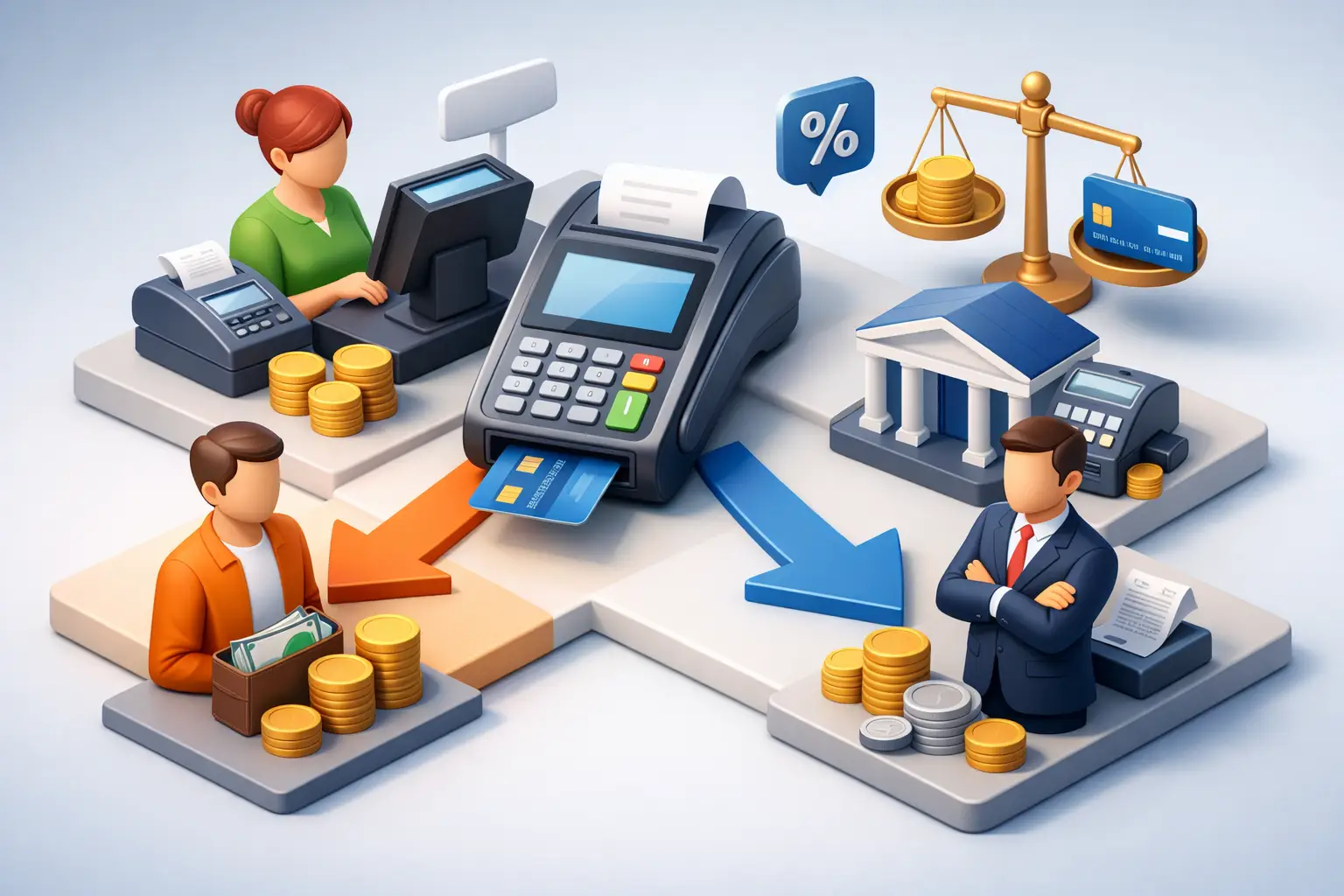
A customer taps a card to pay a $100 invoice, and your business receives less than $100. That gap raises a fair question: who pays credit card processing fees? The immediate answer is usually the merchant. The more useful answer is that a business can decide how to account for those costs in its pricing, provided it does so transparently and within card brand, state, and processor rules.
For a restaurant, dental practice, auto repair shop, salon, or service business, this is not a minor bookkeeping detail. Processing costs affect margins on every card sale. The right approach depends on your customer expectations, average ticket, card volume, checkout process, and the agreement behind your merchant account.
Who Pays Credit Card Processing Fees by Default?
Under a standard merchant account, the business pays the processing fee. When a customer pays by credit or debit card, the processor deducts fees from the transaction amount or collects them through monthly billing. The customer sees the purchase price, while the merchant absorbs the cost as an operating expense.
Those fees typically include interchange, which goes primarily to the card-issuing bank; card brand assessments; and processor markup. A statement may show these charges as one bundled rate or as several line items. Either way, the cost comes from the merchant unless the business uses a compliant pricing program that changes what the customer pays.
That default model is simple for customers. It can also be expensive for businesses that process substantial card volume, particularly when margins are tight. A repair shop may accept a large card payment for a transmission job. A medical office may collect recurring patient balances by card. A restaurant may process hundreds of smaller transactions each day. In each case, a percentage-based fee grows with the sale amount.
The key point is this: card processing is not free. If the merchant does not show a separate charge or build the cost into prices, the merchant pays it directly.
Can a Business Pass Processing Fees to Customers?
Sometimes, but the method matters. Businesses generally have three practical ways to handle card acceptance costs: absorb them, build them into regular prices, or use a properly structured customer-facing pricing program.
Absorbing fees keeps checkout straightforward but reduces the amount the business retains from each card sale. Building costs into overall pricing spreads the expense across all customers, including those who pay with cash or check. A customer-facing program can make card acceptance costs more visible, but it must be implemented carefully to avoid customer confusion and compliance problems.
A business should not simply add an arbitrary “credit card fee” to every transaction. Rules vary based on whether the payment is credit or debit, the card network involved, applicable state requirements, and the processor's program structure. Debit cards, including debit cards run without a PIN, require special attention. A fee that appears reasonable at the register can still be noncompliant if it is applied incorrectly.
Credit Card Surcharging
A surcharge is an added amount charged specifically when a customer uses a credit card. It is not the same as a fee for using any card. Surcharging is subject to card brand rules, disclosure requirements, limits, and state law considerations. It generally cannot be applied to debit or prepaid card transactions, even when the card is processed as credit.
For a business considering a surcharge, accuracy at the terminal and POS level is essential. Staff must know what to say, receipts must display charges correctly, and required notices must be provided. A manual workaround, such as asking employees to add a fee themselves, creates unnecessary risk and inconsistent customer experiences.
Surcharging can fit some professional service firms and higher-ticket businesses, especially where customers are accustomed to seeing payment-related charges. But it can be a poor fit for businesses where speed, hospitality, or price perception drive repeat visits. A coffee shop or casual restaurant, for example, may find that a visible surcharge causes more friction than the savings justify.
Cash Discount Programs
A cash discount program takes a different approach. Instead of starting with a cash price and adding a fee for card use, the business displays a regular price and offers a discount to customers who pay with cash. The customer paying by card pays the posted price; the cash-paying customer receives a discount.
When designed correctly, this model can help a business offset processing costs while giving customers a clear choice. It is often a natural fit for businesses with meaningful cash transactions, such as auto repair shops, tire stores, salons, restaurants, and certain retail locations.
The distinction between a cash discount and a surcharge is more than wording. Signage, price presentation, receipt language, terminal configuration, and staff communication all matter. A program that is marketed as a cash discount but configured like a card surcharge may create compliance and customer-service issues.
Dual Pricing
Dual pricing displays two prices: one for cash and one for card. For example, a business may show a cash price and a slightly higher card price on menus, service estimates, shelf labels, or invoices. Customers see the difference before paying, which can make the policy easier to understand than an unexpected fee at checkout.
Dual pricing can be effective when a business wants greater price transparency without burying card costs in every transaction. It is especially worth evaluating for businesses with clearly posted prices or formal estimates. Still, it requires consistent implementation. If the menu says one thing, the terminal shows another, and the receipt uses unclear language, customers will notice.
What Determines the Best Option for Your Business?
There is no universal answer because the processing fee is only one part of the decision. A business should evaluate the potential savings alongside customer response, operational demands, and the quality of its current payment setup.
Start with your numbers. Review monthly card volume, average ticket size, debit versus credit mix, rewards card volume, keyed transactions, recurring payments, chargebacks, monthly account fees, and equipment costs. A quoted rate alone rarely tells the full story. A lower advertised percentage can be offset by higher transaction fees, account charges, software fees, or restrictive contract terms.
Then consider the customer experience. If your customers receive estimates before approving work, dual pricing may be easy to communicate. If payment happens quickly at a busy counter, a clear cash discount program may be more practical than a conversation about a fee on every sale. For healthcare and professional offices, sensitivity around patient and client payments may make a more traditional pricing model the better choice.
Finally, look at your technology. Your POS system or payment terminal must support the program you choose. It should identify eligible payment types correctly, calculate prices consistently, and produce receipts that match what customers saw before paying. Good payment technology reduces errors; it does not replace sound policy and staff training.
Common Mistakes When Shifting Processing Costs
Businesses often run into trouble not because the idea is wrong, but because the implementation is incomplete. Four mistakes come up repeatedly:
- Adding the same fee to credit and debit transactions without verifying the rules.
- Failing to post clear notices where customers can see them before payment.
- Using language that does not match the program actually configured in the POS or terminal.
- Choosing a program based only on promised savings without reviewing monthly fees, contracts, equipment, and customer impact.
Another common mistake is assuming a processor's “zero-cost” offer means there are no costs at all. Payment acceptance still involves technology, operational work, compliance requirements, and customer choices. The real question is how those costs are allocated and whether the arrangement is transparent, compliant, and appropriate for the business.
A Better Way to Review Processing Fees
Before changing prices or adding a customer-facing program, review your merchant statement and current checkout process together. The statement shows what you are paying. The checkout process shows whether a change will work in practice.
Ask whether your current pricing is clear, whether your equipment supports the approach, whether employees can explain it in one sentence, and whether the expected savings justify the potential customer reaction. If the answer is no, improving your existing merchant account or negotiating unnecessary fees may deliver a better result than changing how customers pay.
For San Antonio businesses, local support can be particularly valuable when a program needs to be configured, tested, and explained to staff. FeeFix Solutions approaches these decisions by reviewing the full payment setup first, not by assuming every business needs to switch processors or pass costs to customers.
The best payment policy is the one your business can explain clearly, run consistently, and stand behind at the counter. When customers understand their options and your numbers support the decision, processing fees become a manageable business choice rather than a monthly surprise.

