A dual pricing program can help a business recover much or all of its card acceptance cost, but the savings depend on more than a posted sign or a new terminal. The right merchant account for dual pricing must support accurate pricing, clear customer communication, dependable reporting, and a checkout process your staff can manage confidently.
For a restaurant, repair shop, dental office, salon, or retail store, dual pricing can improve margins without raising the cash price customers already know. But it is not a fit for every operation. The details of the merchant account, POS system, customer mix, and implementation matter just as much as the advertised processing rate.
What Dual Pricing Actually Means
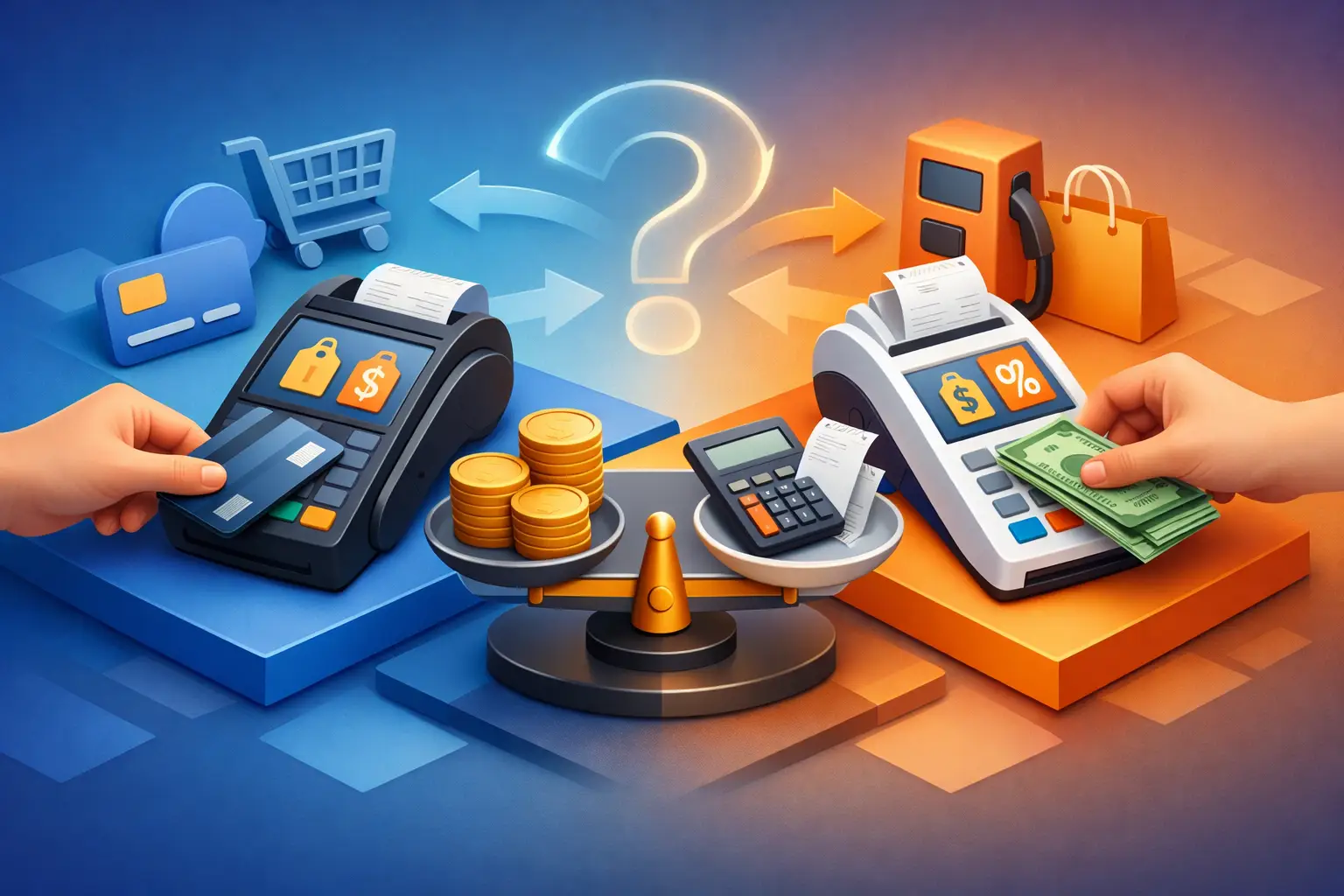
Dual pricing gives customers two clearly displayed prices: one for paying with cash and one for paying with a card. The card price includes the additional cost of accepting card payments, while the cash price remains lower. Customers see the difference before they choose how to pay.
This is different from simply adding an unexplained fee at the register. It is also different from a traditional surcharge program, which adds a fee to certain credit card transactions and has separate card-network rules. A properly structured dual pricing program presents pricing transparently and applies the card price as the regular price when a customer uses an eligible card.
The distinction matters because customers react to surprises. When pricing is displayed clearly on shelves, menus, invoices, service estimates, and payment screens as appropriate, the conversation at checkout is usually straightforward: cash receives the lower price, and cards receive the posted card price.
Why the Merchant Account Matters in a Dual Pricing Program
A merchant account is the payment processing setup that allows your business to accept card payments. For dual pricing, it needs to do more than authorize a transaction. It must work with your payment equipment or POS system to recognize the selected payment method and apply the correct displayed price consistently.
Some providers market dual pricing programs that rely on confusing fees, limited equipment options, or long-term contracts that are difficult to leave. Others quote a low rate without explaining processor fees, monthly charges, equipment costs, PCI-related fees, or how the program is configured. The result can be a program that looks attractive on paper but creates operational problems later.
A suitable merchant account for dual pricing should provide transparent pricing and clear monthly reporting. You should be able to see your card sales, dual pricing amounts, refunds, chargebacks, and any remaining processing costs without sorting through vague line items. If a provider cannot explain how the numbers will appear on your statement, that is worth addressing before you sign.
Your Equipment Must Apply Prices Correctly
The terminal or POS system is central to a compliant and practical setup. It should display the card and cash pricing clearly, calculate the appropriate amount reliably, and produce receipts that match what the customer was shown.
For a counter-service business, a customer-facing payment terminal may be enough. A tire shop or auto repair facility may need the program integrated into invoicing and estimates. Restaurants may need menu pricing, table service, online ordering, and tips to work together without creating confusion. Medical and professional offices may need a process that handles deposits, recurring payments, or balances due after insurance.
Do not assume your existing equipment can support dual pricing properly. Some systems can be configured well; others cannot display or calculate pricing in a way that makes sense for your business. Replacing equipment solely to implement a program may still be worthwhile, but that cost should be part of the decision.
Clear Disclosure Protects the Customer Experience
The goal is not to make card-paying customers feel penalized. The goal is to offer transparent choices and avoid burying payment costs in the prices paid by every customer.
Before implementation, determine where customers first see pricing and where they make the payment decision. A retail store may need shelf labels and a sign near the entrance or register. A restaurant may need menus and counter signage. A home service company may need estimates that explain cash and card totals before the technician collects payment. An office may need written notices in patient or client billing communications.
Your payment screen and receipt should reinforce, not contradict, those disclosures. If the shelf label, invoice, terminal, and receipt show different amounts or descriptions, customers will understandably have questions. Consistency reduces disputes and helps employees explain the program in one clear sentence.
What to Review Before Choosing a Merchant Account for Dual Pricing
Start with your current payment data, not with a sales pitch. Review your monthly card volume, average ticket, transaction count, card mix, refund activity, chargebacks, and the percentage of customers who currently pay by cash, check, or card. A business with mostly small-ticket transactions has different economics than a contractor collecting a few large invoices each week.
Also consider whether your card acceptance costs are actually the problem. If your existing merchant account has high markup, unnecessary fees, or outdated equipment, a statement review may identify savings before any dual pricing program is introduced. In some cases, a better standard processing arrangement is the simpler answer.
When comparing providers, ask direct questions about the following:
- How are cash and card prices displayed on the terminal, POS system, invoice, and receipt?
- Which payments are eligible, including debit cards, credit cards, digital wallets, keyed transactions, and online payments?
- What are the monthly, annual, PCI, gateway, software, support, and equipment fees?
- Is the equipment purchased, leased, or provided under a contract, and what happens if you change processors?
- How are refunds, partial refunds, tips, deposits, disputes, and chargebacks handled?
- Who provides support when a terminal fails during business hours or a customer questions a transaction?
The answers should be specific to your business. A generic promise to eliminate processing fees is not a complete proposal. Payment costs can be reduced significantly, but there may still be account fees, technology costs, or transactions that require special handling.
Compliance Is a Setup Process, Not a Marketing Claim
Card-network requirements, processor policies, state rules, and consumer disclosure expectations can affect how a dual pricing program is structured. Requirements can also change. That is why a provider should evaluate the current rules and configure the program around your location, business model, transaction types, and equipment.
For example, debit card treatment deserves careful attention. A program should not be configured by simply applying the same type of added fee to every payment method without confirming that the setup and disclosures are appropriate. Online payments, phone orders, recurring billing, and invoices sent after service may also require a different approach than a face-to-face counter transaction.
Compliance also depends on daily operations. Staff should know which price applies, how to explain it without improvising, and how to process a refund correctly. A refund that does not follow the original transaction logic can create a customer service issue quickly. Written procedures are especially valuable when multiple employees take payments.
Measure the Financial Benefit After Launch
A dual pricing program should be reviewed after it is active, not treated as a one-time change. Compare your total payment-related costs before and after implementation, including merchant account fees, hardware or software costs, and any changes in cash handling. Look at customer feedback, abandoned transactions, refund patterns, and employee questions as well.
The strongest result is not just a lower processing expense. It is a program that preserves trust, gives customers a clear choice, and works without slowing the register or front desk. If customers consistently misunderstand the pricing, the solution may need better signs, better staff scripting, or a different configuration.
For San Antonio businesses that want a second opinion, FeeFix Solutions can review the current merchant account, payment technology, and customer checkout flow before recommending whether dual pricing makes financial and operational sense.
Before changing how you accept payments, ask one practical question: will this setup be easy to explain at the busiest moment of your day? If the answer is yes, the pricing is clear, and the numbers hold up on your statement, dual pricing may be a meaningful way to protect profit without sacrificing the customer experience.

