If your business is absorbing thousands of dollars a month in card fees, the difference between dual pricing vs cash discount is not a technical detail. It directly affects margin, customer communication, and compliance risk. Many merchants use the terms interchangeably, but they are not the same model, and choosing the wrong structure can create unnecessary exposure.
For business owners focused on preserving profitability, this decision should be made with the same care as any pricing decision. The right program can reduce processing expense and keep checkout simple. The wrong one can confuse customers, frustrate staff, and create problems with how pricing is disclosed.
What dual pricing vs cash discount actually means
At a high level, both models are designed to address the cost of card acceptance. That is where the similarity ends.
A cash discount program starts with the regular posted price as the card price. Customers who pay with cash receive a discount off that amount at the point of sale. In practical terms, the merchant is offering a lower price to cash-paying customers.
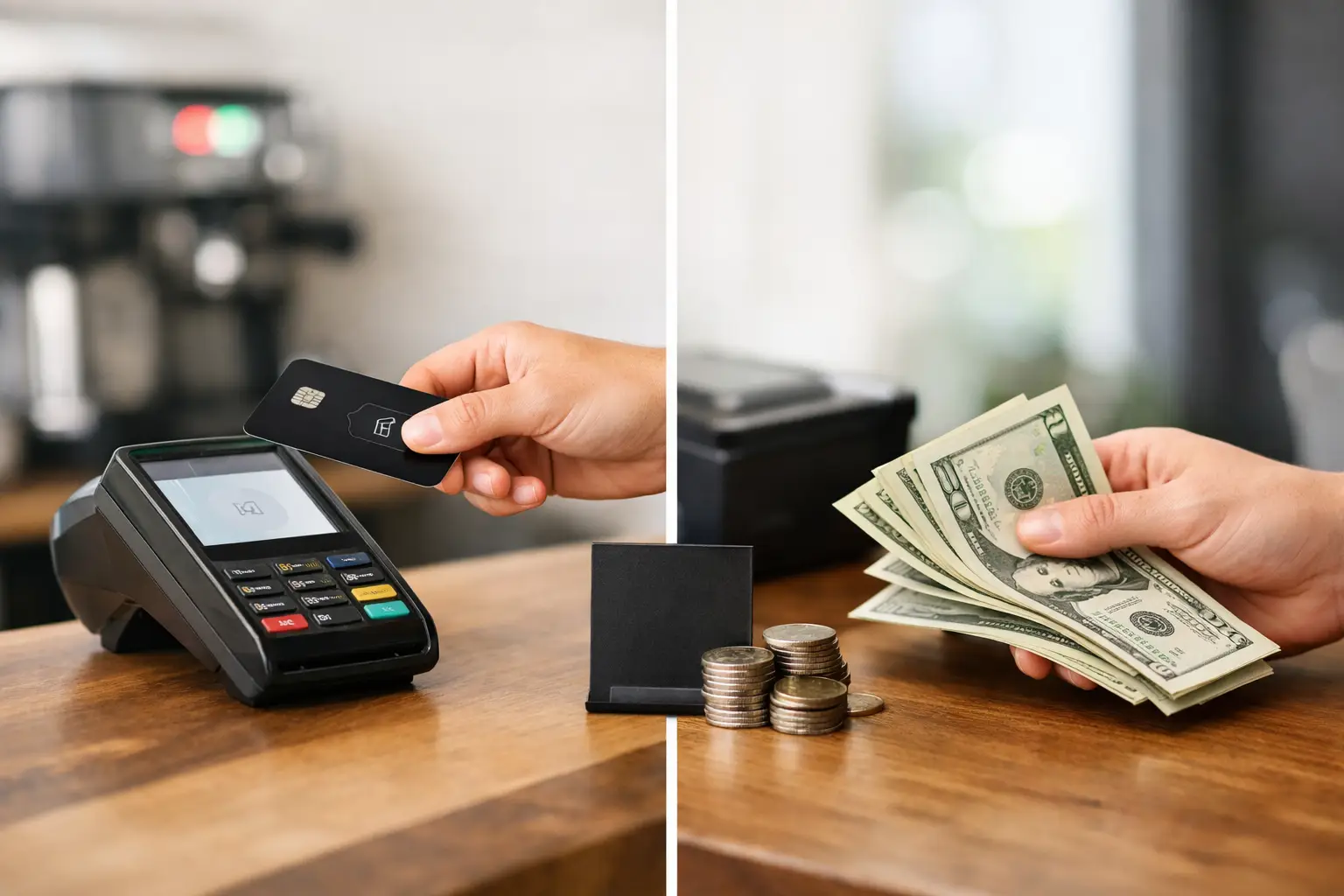
A dual pricing program works differently. It presents separate pricing based on payment method. One price applies to cash, and a higher price applies to card transactions. The pricing structure is disclosed upfront so the customer can see the difference before they pay.
That distinction matters. In a true cash discount model, the merchant is discounting from the standard price for cash. In a true dual pricing model, the merchant is presenting two prices transparently based on how the customer chooses to pay.
Why the difference matters more than most merchants think
From a business perspective, both approaches aim to offset processing costs. But the legal and operational details are where merchants can run into trouble.
The biggest issue is presentation. If a business calls something a cash discount but displays pricing like a card surcharge, that mismatch can create compliance concerns. Card brand rules, state-level requirements, receipt formatting, and signage expectations all depend on how the program is structured and disclosed.
This is why many merchants benefit from a dual pricing setup when it is implemented correctly. It is built around transparent price presentation rather than trying to explain an adjustment after the fact. Customers can see the cash price and card price clearly, which reduces confusion and makes the transaction easier for staff to manage.
For operators with multiple employees, high transaction volume, or several locations, that clarity matters. The simpler the explanation at the register, the more likely the program will be applied consistently.
How a cash discount program works in practice
With a cash discount model, the shelf or menu price is generally treated as the standard price. When a customer pays with cash, a discount is applied. If they pay with a card, they pay the posted amount.
That sounds straightforward, but execution can get messy. Staff has to understand that the listed price is the card price, while the discount is only applied for cash. Signage needs to explain the policy clearly. Receipts should reflect the transaction in a way that aligns with the program structure.
This model can work for some merchants, especially in environments where cash is still common and customer interactions are straightforward. But it depends heavily on consistent communication. If customers feel surprised by the final total or do not understand why one payment type is treated differently, the merchant absorbs the friction.
How dual pricing works in practice
Dual pricing is typically easier for merchants who want more direct transparency. The business presents a cash price and a card price, and the customer chooses which applies based on payment method.
That means pricing is not adjusted in a way that feels hidden or reactive. It is disclosed from the start. In many settings, that is simply cleaner. Customers know what to expect, and employees do not have to explain a discount after the transaction is already in motion.
For businesses that process a significant amount of card volume, dual pricing can be a more practical framework because it aligns pricing presentation with customer choice. It also supports a stronger compliance posture when the system, signage, receipts, and point-of-sale setup are all configured correctly.
This is where a partner with experience matters. The model itself is only part of the equation. The implementation has to match the intended structure.
Dual pricing vs cash discount for compliance
When merchants compare dual pricing vs cash discount, compliance should be near the top of the conversation. Saving money on processing fees is valuable, but not if the program is loosely set up and creates avoidable risk.
Compliance is not just about one rule. It is about how the pricing is advertised, how the register calculates totals, what appears on receipts, and whether the customer is informed before payment. It also depends on payment network expectations and, in some cases, state-specific requirements.
A poorly explained cash discount can be mistaken for a surcharge. A poorly configured dual pricing program can create the same kind of issue. What protects the merchant is not the label alone. It is whether the structure is compliant, transparent, and supported by the right operational setup.
That is one reason many business owners move toward dual pricing with an experienced provider. The goal is not just to reduce fees. The goal is to reduce fees through a model that is easier to defend, easier to explain, and easier to run consistently.
Which model is better for customer experience?
That depends on your business type, your average ticket size, and how customers interact with your pricing.
If you operate in a cash-heavy environment where customers are used to cash incentives, a cash discount may feel familiar. Convenience stores, small service businesses, and some local retail operations can sometimes make it work without much resistance.
But many businesses today are card-dominant. In those settings, dual pricing often creates a better customer experience because it is more transparent. Customers can see their options clearly. There is less room for confusion at checkout, and less burden on staff to explain why the total changed.
Hospitality, automotive services, professional services, medical practices, and multi-location retailers often benefit from this clarity. When the majority of customers pay by card, clear posted pricing tends to create fewer disputes than a discount model that only becomes obvious at the register.
Which model is better for profitability?
Both can help offset processing costs, but dual pricing is often the better fit for merchants focused on predictable margin protection.
The reason is simple. Dual pricing is typically designed to make the economics visible and repeatable. The pricing structure is built into the customer transaction from the beginning, which can make it easier to preserve margin consistently across locations, employees, and transaction types.
Cash discount can still reduce costs, but in some businesses it is more vulnerable to inconsistent execution. If signage is weak, staff explanations vary, or discounts are not applied correctly, the intended financial benefit can erode.
Profitability is not just about the program concept. It is about whether the model works in real operations, during busy shifts, with new employees, and across every payment touchpoint.
How to choose the right approach for your business
Start with customer behavior. If nearly all of your sales are on cards, your pricing model should reflect that reality rather than fight it. Then look at your operational complexity. The more employees, terminals, or locations you have, the more valuable simplicity and consistency become.
Next, consider how sensitive your business is to customer perception. If pricing disputes slow down checkout or affect retention, transparency should carry more weight in your decision. Finally, look at who is helping you implement the program. A provider that only talks about rates is not solving the real issue. You need a structure that is configured correctly from day one.
For many small and mid-sized merchants, dual pricing is the stronger long-term answer because it combines fee reduction with clearer customer communication. That is why companies like FeeFix Solutions focus on compliant dual pricing programs rather than generic processor promises about low rates.
The better question to ask
Instead of asking which label sounds better, ask which model your business can operate cleanly, transparently, and compliantly every day. That is the standard that matters.
Payment costs are too significant to treat as background noise. When your pricing structure is built to protect margin and withstand scrutiny, the benefit goes beyond savings. You gain a system your team can explain, your customers can understand, and your business can scale with confidence.

