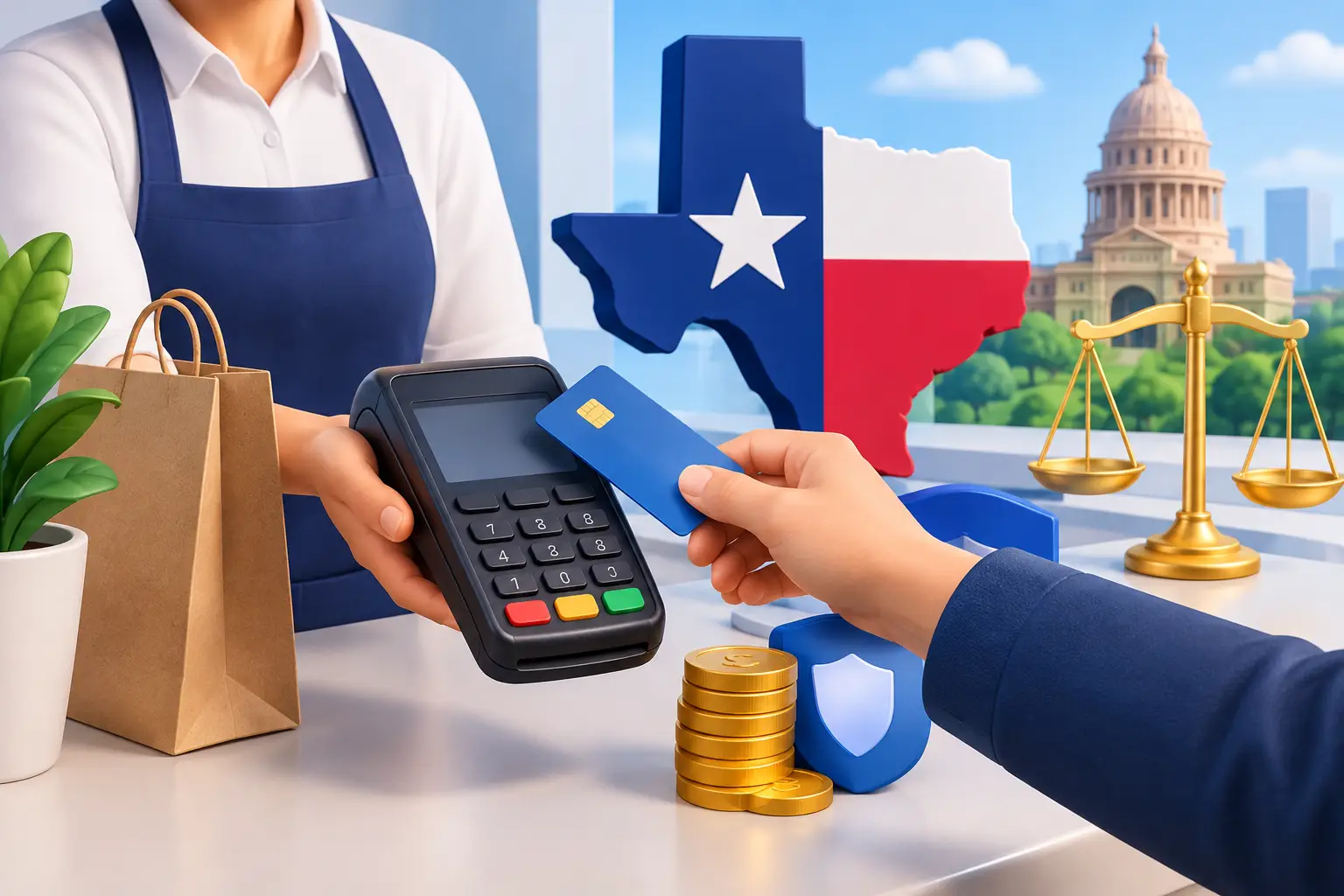
A customer hands over a card for a $100 repair, dental visit, or restaurant tab. At checkout, the total becomes $103. Whether that extra $3 protects your margin or creates a complaint depends on how the program was built. Can businesses add card fees? In Texas, many can add a fee to eligible credit card transactions, but the details matter. The wrong setup can create card-brand compliance issues, confuse customers, and damage the payment experience you worked hard to build.
For a business paying thousands of dollars each month in processing costs, passing along some of that expense can be a practical option. It is not automatically the right option. A thoughtful decision starts with the payment method, your pricing model, your industry, and what your customers will reasonably accept.
Can businesses add card fees in Texas?
Texas businesses may generally charge a surcharge on credit card purchases when they follow applicable card-network rules, disclosure requirements, and processor requirements. A surcharge is an added amount charged specifically because a customer chooses to pay with a credit card.
The most important limitation is straightforward: you cannot surcharge a debit card transaction, even when the debit card is run without a PIN or appears similar to a credit card at the terminal. Prepaid cards should also be treated carefully. Your payment system needs to identify eligible card types correctly so a surcharge is not applied where it is prohibited.
For credit cards, the surcharge cannot be used as a profit center. It generally must not exceed your actual cost of acceptance, and major card-brand rules may impose a lower cap. For many merchants, that means a maximum surcharge of 3%, even if their overall processing expense is higher. Your processor and program provider should confirm the limit that applies to your setup before you turn anything on.
Businesses also need clear customer notice. Customers should see that a credit card surcharge applies before they decide how to pay, and the receipt should show the surcharge as a separate line item. Card brands and processors can have advance-notification requirements as well. A terminal setting alone is not a complete compliance program.
A card fee is not the same as dual pricing or cash discounting
Business owners often use terms such as surcharge, cash discount, and dual pricing interchangeably. They are not the same model, and the difference affects how prices are presented and how customers experience checkout.
Credit card surcharge
A surcharge adds an amount when an eligible customer uses a credit card. The advertised price is typically the card price, with the fee disclosed separately at checkout. This model can be easy for customers to understand when notices are clear, but it requires careful debit-card controls and attention to card-brand rules.
Cash discount
A cash discount starts with the standard posted price and gives customers a discount when they pay with cash. Done properly, the customer receives a real reduction for using cash rather than being surprised by an unexplained charge for using a card. This approach can work well for businesses with a meaningful share of cash-paying customers, though it may have less impact for offices or service businesses where nearly everyone pays by card.
Dual pricing
Dual pricing displays two prices upfront: one for cash and one for card. The customer sees both options before deciding how to pay. For many merchants, this is the clearest way to address payment costs because the card price is presented as a price, not added as an unexpected final charge.
There is no universally best choice. A quick-service restaurant may prefer a model that keeps checkout moving. An auto repair shop may find dual pricing easy to explain on a larger ticket. A medical or dental office may need a more measured approach because patients can be especially sensitive to unexpected charges. The right answer depends on customer expectations as much as processing costs.
What a compliant customer experience looks like
Compliance begins before the payment terminal. Your menu, estimate, invoice, price board, online payment page, and employee language should all match the pricing model you choose. If your printed estimate says $500 but a card payment produces a higher amount with no earlier explanation, the customer may feel misled even if the fee is technically disclosed at the final screen.
Clear communication is usually simple: state that card pricing or a credit card surcharge applies, show the amount or percentage where required, and give customers time to choose another payment method. Avoid vague labels such as “service fee” or “non-cash adjustment” when they do not accurately describe what the customer is paying.
Your team also needs a short, consistent explanation. Employees should not have to debate interchange rates or card-brand regulations at the counter. They should be able to say, plainly, that the business offers a cash price and a card price, or that a disclosed credit card surcharge helps cover card acceptance costs. A calm explanation can prevent a small checkout question from becoming a negative review.
Online, invoices, and recurring payments need extra attention
A program that works at the front counter may not translate automatically to every payment channel. Online checkout pages need upfront disclosure. Invoices sent by text or email should show the applicable card price or surcharge before the customer submits payment. For recurring billing, customers need appropriate notice before a fee is applied to future card payments.
This is especially relevant for home service companies, professional firms, medical practices, and businesses that collect deposits or balances remotely. Review every path a customer can take to pay, not just the terminal at the register.
Do the savings justify the change?
Passing through card costs can improve margins, but the projected savings should be measured against the possible operational and customer costs. A business that processes $80,000 per month in eligible credit card volume may see a meaningful reduction in direct processing expense. But that result changes if customers switch to lower-margin alternatives, abandon online payments, dispute transactions, or choose a competitor with simpler pricing.
Start with the real numbers on your merchant statement. Separate credit card volume from debit volume, identify your effective processing rate, and look for fees that are unrelated to the cost of accepting a specific card payment. Not every line item can be passed to a customer through a surcharge program.
Then consider the nature of your transactions. Higher-ticket, one-time purchases may be more likely to create fee questions. Small-ticket transactions can make a percentage fee feel disproportionate to customers. Businesses with highly competitive advertised pricing may prefer to build card acceptance into their prices rather than call it out at checkout.
A pricing program should also be weighed against alternatives. Sometimes a merchant account review, better processor pricing, the right POS configuration, or eliminating unnecessary add-on fees can reduce costs without changing the customer-facing price at all. If your existing setup is already competitive and your customers value a single all-in price, keeping the status quo may be the better business decision.
Common mistakes that create problems
Most card-fee issues are preventable. They usually begin with a program that was activated quickly without a full review of payment methods, signs, receipts, and staff procedures.
Watch for these four problems:
- Applying the same fee to debit and credit cards because the terminal cannot distinguish them correctly.
- Charging more than the permitted amount or using a flat fee that exceeds the allowed percentage on smaller purchases.
- Posting notices only at the register, even though customers receive estimates, order online, or pay invoices remotely.
- Calling a surcharge a cash discount, or calling a dual-price program a surcharge, without aligning the actual pricing and disclosures.
There is also a technology issue. Older terminals, basic virtual terminals, and some POS systems may not support compliant fee logic across every payment channel. Manually adding a fee may seem convenient, but it introduces inconsistency and makes audit trails harder to manage. The system should apply the correct rule automatically, display it clearly, and keep the receipt accurate.
Before you add a card fee
Before launching any program, review your merchant statement, card mix, transaction sizes, customer payment habits, and every point where customers see a price. Confirm that your processor supports the model you want and that it can exclude debit cards reliably. Make sure required notices, receipts, invoices, and online pages are configured before the program goes live.
It is also wise to get a second opinion if a provider promises that all processing fees can simply be eliminated. Card acceptance has real costs, and compliance depends on the details. A transparent program can reduce expense and protect profitability. A poorly explained one can cost more in customer trust than it saves.
For San Antonio businesses, the best payment strategy is usually the one that fits the way customers already buy from you. FeeFix Solutions can review the numbers, technology, and customer experience behind the decision so you can choose a compliant approach with confidence. The goal is not merely to move a fee. It is to make a payment decision that supports your margins without making checkout harder for the people who keep your business growing.

